
Technical Service
Clause on the performance of the service
This document outlines the guidelines of the three main activities carried out by the accredited body: the inspection activity, the testing activity, the approval activity and the related general obligations in compliance with European Regulation 2018/858, 167/2013 and 168/2013.
The Customer, by accepting the offer sent, declares to have read and understood the information contained therein.
1. INSPECTION ACTIVITIES
The points listed below are intended to inform the Customer and the Testing Organization about the main topics that will be analyzed and deepened during the inspection of the test activity.
- 1.1 PURPOSE AND SCOPE
- The purpose of the inspection is to assess that the results of the test performed at the testing organization are valid and reliable. This objective is pursued through the verification, carried out during the inspection, of the adequacy of the instrumentation used for the test activities, the related certificates, the analysis of the procedures and all aspects related to the test activity, the supervision of the execution of the test activities, the examination of the Test Report and in any case the evaluation of all those aspects that may influence the result of the test activities.Following the inspection of the test activity, the results will be considered reliable or not and therefore may or may not be used by GreenKar Technical Service for any related activities; if necessary, the Inspection Body is available for explanations of the results.
- 1.2 TESTING ORGANIZATION REQUIREMENTS
- Unless otherwise requested by the Customer, the Inspection Manager is authorized to interface with all personnel of the Testing Organization.The Testing Organization must have a Technical Manager to whom GreenKar Technical Service will report and who will indicate to the Inspection Manager the personnel who will carry out the testing activities.
The staff indicated must be in possession of the necessary skills to carry out the test; these skills will be verified through documentary analysis. The test activities subject to inspection must comply with the provisions of the test reference standard.
The Testing Organization must ensure compliance with all safety conditions during the tests as required by the Regulations in force; the test organization must notify the inspector in advance of the assessment made on the risks inherent in the test activity and must also provide the inspector with any personal safety equipment that is provided for laboratory personnel. GreenKar Technical Service does not authorize its personnel to proceed with the inspection of the test activity if the safety conditions provided by the Testing Organization are not respected.
- 1.3 EQUIPMENT
GreenKar Technical Service will only verify the instruments and related documentation if they are used during the inspected test activities. The test organization must be equipped with all equipment (and related software, if any) that comply with the test specifications. By accepting the Commercial Quotation, the Customer declares and assumes responsibility that the Testing Organization will use working equipment; the Client at his discretion may appeal to the Testing Organization. All equipment, those used for the tests as well as those for detecting environmental conditions when these may affect the outcome of the tests, must be functional and calibrated (evaluated during the inspection), with the calibration certificate valid for the period of the tests.During the planning phase of the inspection, the Testing Organization will be asked to provide the list and calibration certificates of the instruments that will be used for the testing activities for a preventive check, in order to assess in advance the compliance of the instrumentation with the requirements. In the event that there is no communication in this regard from the Inspection Body, the customer will be informed and will have the right to cancel the activity. In the absence of cancellation, the technical staff of the Inspection Body will proceed with the planning and organization of the trip to the Testing Organization, assuming that the instruments and documents mentioned comply with the requirements.This preventive check does not exclude the analysis of the instruments and therefore of the related Calibration Certificates during the inspection of the test activity.
In the event that, during the inspection of the instruments and related documents, large findings emerge that undermine the reliability of the result of the tests, the Client will be informed who, at his discretion, may decide whether or not to continue the activities. In the event of early termination, the service will still be considered provided and travel costs will be charged to the Customer; if, on the other hand, the Customer still intends to continue with the inspection, the inspector will proceed with the activity, and will record the negative outcome of the inspection. The test result obtained cannot therefore be considered reliable for the purposes of a possible certification of the tested product.
1.4 KEEPING DATA UNDER CONTROL- Where test equipment management or data processing software is used for the test activities inspected, the testing organization shall ensure that it is adequate and allows a reliable result to be issued. The hardware and software components present and used to carry out the inspected tests must be classified and if the hardware/software component can be calibrated, a valid calibration certificate must be available.
- 1.5 SPECIFIC REQUIREMENTS FOR THE TRACEABILITY OF MEASUREMENTS
- subject to evaluation by the Inspection Officer to determine acceptability based on the type of measurement and test. For internal calibrations, the competence of the Testing Organization in carrying out calibrations will not be verified during the inspection activities but also in this case the Inspection Officer will evaluate the acceptability of the calibration based on the type of measurement and test. The Calibration Certificates of each instrument must contain the results of the measurements and there must be evidence of reference to the standard measurements of the International System of Units (SI).
- 1.6 TEST METHODS
- The Testing Organization shall adopt appropriate methods and procedures (evaluated during inspection) for all tests it intends to perform according to the required Standards.
- 1.7 TECHNICAL RECORDS
- The technical records of the Testing Organization shall include the identity of the personnel responsible for carrying out each test.
- 1.8 CHANGES TO TEST REPORTS
- The Testing Organization, in the event of changes to the test reports of the inspected tests, must issue a new document; this document must be clearly named as a substitute for the previous one, contain the references of the original and be uniquely identified.
2. TESTING ACTIVITIES
- 2.1 PURPOSE AND SCOPE
- The purpose of the testing activity performed by the Greenkar Technical Service laboratory is to ensure the production of valid and reliable test results, demonstrating technical competence and the adequacy of its resources. The Laboratory believes that the assurance of the result of the test methods applied is guaranteed by the control of the instrumentation and its certificates, by the analysis of the procedures and all the aspects inherent to the test activity, and, in any case, the evaluation of all those aspects that may influence the result of the test activities.Following the test activity, the results will be considered reliable or not and therefore may or may not be used by GreenKar Technical Service for any related activities. The Greenkar Technical Service Test Officer will issue a test report.
- 2.2 REQUIREMENTS FOR TESTING ACTIVITIES
- The tests can also be carried out in areas outside the laboratory, at sites deemed suitable for the necessary checks and verifications made available by the Customer.For test methods that require particular environmental conditions, the Officer monitors that these conditions are met throughout the duration of the test.
- In the event that the environmental conditions do not fall within the range required by the method, the test is suspended and resumed when the necessary conditions have been restored.If the test method requires it, the type of site must be checked, e.g. flatness, soil conditions, lighting.
The Test Officer is in possession of the names of the authorized personnel, illustrating the behavior to be followed and the operations to be carried out during the tests.
If other activities are carried out on the site and therefore unauthorized personnel are potentially present, the Test Officer, assessing that these presences do not compromise the test results, delimits the test area with clearly visible dividers to prevent unauthorized personnel from entering the area used for the test. In the event that unauthorized personnel enter the test site, or the authorized personnel do not comply with the instructions given by the Test officer, the latter will suspend the test until the conditions required by the method are restored.
In the test activity, the Customer makes available the test sample, it follows that GreenKar Technical Service has no responsibility for transport, receipt, storage, protection and disposal activities. The Test officer is authorized exclusively to handle the product in order to adapt it to the test equipment or to apply test instruments on it, provided that these activities do not involve the disassembly or tampering of any component of the sample; is not authorized in any case to handle the sample, an operation under the responsibility of the personnel authorized by the Customer. If there is an urgency or need to handle the sample, the Test Officer may exceptionally be authorized to handle it only if no safety conditions are lacking; an example would be to make small movements of the sample to place it on the scales or on a surface suitable for size detection operations.
The test samples therefore remain under the control and supervision of the Customer.
- 2.3 INSTRUMENT MANAGEMENT
All the measuring instruments available for use by the Laboratory are suitably calibrated at LAT centers or in any case by calibration laboratories accredited by an Accreditation Body that is a signatory to the EA MLA or ILAC MRA agreement.The laboratory operates its instruments according to the requirements of ISO/IEC 17025:2018. If requested by the Customer, the Test Officer is required to show a valid copy of the calibration certificate, which will always accompany the instruments in the appropriate protective cases.
- 2.4 TEST METHODS
The laboratory is in possession of the latest regulatory revisions. It will be the Customer’s responsibility to specify exactly the standard containing the test method to be used.
- 2.5 MANAGING TEST REPORTS
- At the end of the execution of each test, the related test report is compiled. The preparation of the test report is alwaysthe responsibility of the test officer who carries out the test, who assumes responsibility for the data entered in the document by signing the last page of the document. The report is then validated by the Laboratory manager.
Any information provided by the Customer will be clearly identified and if this affects the validity of the results, the disclaimer will be specified “The laboratory reports the values provided by the manufacturer, but does not assume any responsibility.”
In the event that the Customer requests additional information, this may be reported on an attachment.
If the need arises to modify the test report and the modification or error is ascertained, especially in the second case, the impact of the error on the activity carried out is assessed.
A new test report will then be issued to be delivered to the Customer and whose name will follow that of the test report that it will replace, distinguished by the final addition of the revision index. Where appropriate, the reason for the change will be indicated.
- 2.6 CONFORMITY ASSESSMENT OR NON-CONFORMITY
- When comparing a test result with a specified limit, the Laboratory assesses its conformity with the given requirement. The permitted limits are established by the Regulations under which the tests are performed, in accordance with the decision making requirements of ILAC G8:09/2019 Guidelines on Decision Rules and Statements of Conformity.If the result is close to the limit, the laboratory, after carrying out the risk assessment, applies the decision rule stated in point 4.2.3 of ILAC G8:09/2019, where U = w:
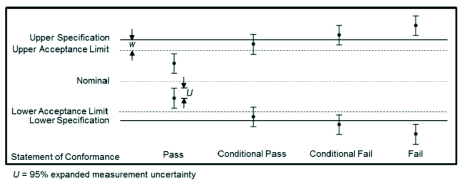
If the result is within the guard bands, according to the cases shown in the figures, therefore in the test report, will be recorded next to the result:
1) Pass – the measured result is below the acceptance limit.
2) Conditional Pass – the measured result is within the guard band and below the tolerance limit in the range.
3) Conditional Fail – the measured result is above the tolerance limit but below the tolerance limit plus the guard band in the range.
4) Fail – the measured result is above the tolerance limit plus the guard band.
3. USE OF ACCREDITATION MARK
- The performance of activities under accreditation will be signalled with the use of the mark in the means established by the Accreditation Body.
4. TYPE-APPROVAL ACTIVITIES, GENERAL OBLIGATIONS
(According to EU Regulations 2018/858, EU 167/2013 and EU 168/2013)
- Type-approval is the procedure by which the type-approval Authority declares that a type of vehicle or device (including “systems”, “components” and “technical units”) complies with the relevant technical requirements, once the tests required by the relevant legislation have been carried out and passed. The document certifying that the approval has been obtained is the “type approval certificate”, identified by an alphanumeric code.Pursuant to Regulations (EU) 2018/858, 167/2013 and 168/2013, the Type Approval Authority maintains a decision‑making and supervisory role over the entire process: it is the competent body responsible for granting or refusing a type‑approval (as set out in Articles 26 and 54 of Regulation (EU) 2018/858; Article 24 of Regulation (EU) 167/2013; Article 29 of Regulation (EU) 168/2013), as well as for assessing the suitability and performance of the designated Technical Services (as set out in Articles 67–68 and 73–76 of Regulation (EU) 2018/858; Article 59 of Regulation (EU) 167/2013; Article 63 of Regulation (EU) 168/2013).
Having been designated as a Technical Service, GreenKar Technical Service provides services aimed at obtaining global, partial, and individual approvals issued by the Type Approval Authorities for various types of vehicles/devices. In this role, GreenKar Technical Service performs testing, inspection, and technical assessment activities on behalf of the Authority, but does not assume any decision‑making responsibility regarding the outcome of the approval.
- 4.1 OBLIGATIONS OF TECHNICAL SERVICE
GreenKar Technical Service Ltd., as a designated Technical Service according to art. 68 of EU Regulation 2018/858 and according to Regulation EU 2013/167 and 2013/168, is required to inform the Type Approval Authority from which it received designation, in the following cases:
- finding of non-compliance of a manufacturer with the provisions of the Framework Regulation, such as to lead to the refusal, limitation, suspension or withdrawal of a type-approval certificate;
- in the event of any circumstances that may affect the scope and conditions of its designation;
- any requests for information received from the Market Surveillance Authorities in relation to its activitiesGreenKar Technical Service also undertakes to:
- provide information to the Type Approval Authority, if requested, regarding its activities as a Technical service;
- allow the Type Approval Authority and the Accreditation Body to witness the type-approval activities, informing any third parties involved. The presence of personnel from the Approval Authorities and the Accreditation Body will be communicated to the Client for their information prior to the execution of the test or inspection.
- always inform the Accreditation Body (and possibly the Approval Authorities when deemed appropriate) of any changes which may affect the compliance with the requirements of Articles 68 to 72 of EU Regulation 2018/858 or their ability to perform the conformity assessment tasks relating to the vehicles, systems, components and separate technical units for which they have been designated.
- 4.2 OBLIGATIONS OF THE MANUFACTURER
- Manufacturer guarantees that the vehicles, systems, components and separate technical units manufactured by them and placed on the market have been manufactured and approved in accordance with the requirements established by the Regulation (Art. 13 EU Regulation 2018/858).Manufacturer is responsible to the type-approval Authority for all aspects of the type-approval procedure and for ensuring conformity of production.
In the case of a multi-stage type-approval, the manufacturer is also responsible for the type-approval and conformity of the production of the systems, components or separate technical units that they have added at the stage of completing the vehicle. A manufacturer who modifies components, systems or separate technical units that have already been approved in previous stages is responsible for the approval and conformity of the production of the components, the modified systems and independent technical units.
Manufacturer of the previous stage shall provide the manufacturer of the next stage with information on any variation that may affect the type-approval of a component, system or separate technical unit or the overall type-approval of a vehicle type. This information shall be provided as soon as the new extension of the overall type-approval of a vehicle type has been granted and at the latest on the date of the start of construction of the incomplete vehicle.
Manufacturer who modifies an incomplete vehicle in such a manner that it qualifies as a different category of vehicle, with the consequence that the requirements already assessed in a previous stage of type-approval have changed, shall also be responsible for compliance with the requirements applicable to the category of vehicles for which the modified vehicle qualifies.
For the purposes of EU type-approval of vehicles, systems, components and separate technical units, a manufacturer established outside the Union shall appoint a single representative established within the Union to represent the manufacturer before the approval authority. That manufacturer shall also appoint a single representative established within the Union for the purposes of market surveillance, who may be the same as the representative appointed for the purposes of EU type-approval.
Manufacturer shall ensure that their vehicles, systems, components and separate technical units are not designed to incorporate strategies or other means that alter the performance exhibited during test procedures in such a way that they do not comply with Regulation EU 2018/858 when operating under conditions that can reasonably be expected in normal operation.
Manufacturer shall establish procedures to ensure that series production of vehicles, systems, components and separate technical units remains in conformity with the approved type.
Manufacturer shall examine any complaints they receive relating to risks, suspected incidents or non-compliance issues with the vehicles, systems, components, separate technical units, parts and equipment that they have placed on the market.
Manufacturer shall keep a record of such complaints, including for each complaint a description of the issue and the details needed to precisely identify the affected type of vehicle, system, component, separate technical unit, part or equipment, and, in the case of substantiated complaints, manufacturer shall keep their distributors and importers informed thereof.
In addition to the statutory plate fixed to their vehicles and type-approval marks fixed to their components or separate technical units, the manufacturers shall indicate their name, registered trade name or registered trade mark and their contact address in the Union on their vehicles, components or separate technical units made available on the market or, where that is not possible, on the packaging or in a document accompanying the component or separate technical unit.
Manufacturer shall ensure that, while a vehicle, system, component or separate technical unit is under their responsibility, storage or transport conditions do not jeopardise its compliance with the requirements laid down in the EU Regulation 2018/858.
Manufacturer of vehicles shall make available data which is needed for testing by third parties for possible non- compliance, including all parameters and settings that are necessary to accurately replicate the test conditions that were applied at the time of the type-approval testing.
Where vehicles, systems, components, separate technical units, parts or accessories that have been placed on the market or that have entered into service do not comply with Regulation EU 2018/858 or where type-approval has been granted on the basis of incorrect data, the manufacturer shall immediately take the necessary corrective measures to bring those vehicles, systems, components, separate technical units into conformity, parts or accessories, to withdraw them from the market or to recall them, as applicable.
Manufacturer shall immediately inform the type-approval Authority that issued the type-approval, detailing the non-conformity and the measures taken.
For further details, please refer to Articles 13 and 14 of CHAPTER II of EU Regulation 2018/858, where applicable Articles 8 and 9 of CHAPTER II of EU Regulation 167/2013 and Articles 9 and 10 of CHAPTER II of EU Regulation 168/2013.
4.3 OBLIGATIONS OF MANUFACTURER’S REPRESENTATIVE
The manufacturer’s representative shall perform the tasks specified in the mandate received from the manufacturer. That mandate shall at least, provide for the representative to:
a) have access to the EU type-approval certificate and its attachments referred to in Article 28(1), and to the certificate of conformity in one of the official Union languages; such documentation shall be made available to the approval authorities and to the market surveillance authorities for a period of 10 years after the end of the validity of the EU type-approval of a vehicle and for a period of five years after the end of validity of the EU type-approval of a system, component or separate technical unit;
b) provide an approval authority, following a reasoned request from that authority, with all information, documentation and any other technical specifications, including access to software and algorithms, that are necessary to demonstrate the conformity of production of a vehicle, system, component or separate technical unit;
c) cooperate with the approval authorities or the market surveillance authorities, at their request, on any action taken to eliminate the serious risk posed by vehicles, systems, components, separate technical units, parts or equipment covered by that mandate;
d) immediately inform the manufacturer about complaints and reports relating to risks, suspected incidents or non-compliance issues that relate to vehicles, systems, components, separate technical units, parts or equipment covered by that mandate;
e) have the right to terminate the mandate without penalty if the manufacturer acts contrary to its obligations under Regulation. The manufacturer’s representative who terminates the mandate shall immediately inform both the approval Authority that granted the type-approval and the Commission. (Article 15 of Chapter II of EU Regulation 2018/858, Article 10 of Chapter II of EU Regulation 167/2013 and Article 11 of Chapter II of EU Regulation 168/2013).
4.4 OBLIGATIONS OF IMPORTERS
Before placing on the market a type-approved vehicle, system, component or separate technical unit, importers shall verify that it is covered by a valid EU type-approval certificate and that the system, component or separate technical unit bears the required type-approval mark and complies with Article 13(8) of Regulation EU 2018/858. In the case of a vehicle, the importer shall ensure that the vehicle is accompanied by the required certificate of conformity.
Where a vehicle, system, component or separate technical unit is not in conformity with the requirements of the Regulation EU 2018/858, and in particular where it does not correspond to its type-approval, importers shall not place on the market, allow to enter into service or register the vehicle, system, component or separate technical unit, until it has been brought into conformity.
Where a vehicle, system, component, separate technical unit, part or equipment presents a serious risk, importers shall inform the manufacturer and the market surveillance authorities thereof. For type- approved vehicles, systems, components and separate technical units, importers shall also inform the approval authority that granted the type- approval.
Importers shall indicate their name, registered trade name or registered trade mark, and their contact address on the vehicle, component, separate technical unit, part or equipment, or, where this is not possible, on its packaging or in a document accompanying the component, separate technical unit, part or equipment. Importers shall ensure that the vehicle, system, component or separate technical unit is accompanied by instructions and information, as required by Article 59 of Reg. UE 2018/858, in the official language or languages of the Member States concerned.
To protect the health and safety of consumers, importers shall keep a record of complaints and recalls relating to vehicles, systems, components, separate technical units, parts or equipment that they have placed on the market, and shall keep their distributors informed of such complaints and recalls.
Importers shall immediately inform the relevant manufacturer of any complaints they received regarding risks, suspected incidents or non-compliance issues relating to vehicles, systems, components, separate technical units, parts or equipment that they have placed on the market. Importers shall ensure that, while a vehicle, system, component or separate technical unit is under their responsibility, storage or transport conditions do not jeopardise its compliance with the requirements laid down in the Regulation EU 2018/858. Where a vehicle, system, component, separate technical unit, part or equipment that has been placed on the market by importers is not in conformity with this Regulation, importers shall immediately take the corrective measures necessary to bring that vehicle, system, component, separate technical unit, part or equipment into conformity under the manufacturer’s supervision, to withdraw it from the market or to recall it, as appropriate. Importers shall also inform the manufacturer and the approval authority that granted the EU type-approval.
Where a vehicle, system, component, separate technical unit, part or equipment that has been placed on the market presents a serious risk, importers shall immediately provide detailed information on the serious risk to the manufacturers and the approval authorities and market surveillance authorities. Importers shall also inform the approval authorities and market surveillance authorities of any action taken and give details, in particular of the serious risk and of any measure taken by the manufacturer.
For further details, please refer to Articles 16 and 17 of CHAPTER II of EU Regulation 2018/858, Article 20 of CHAPTER II of EU Regulation 2018/858, where applicable Articles 11 and 12 of CHAPTER II of EU Regulation 167/2013, Articles 12 and 13 of CHAPTER II of EU Regulation 168/2013.
4.5 OBLIGATIONS OF DISTRIBUTORS
Distributors shall verify, before making available on the market a vehicle, system, component or separate technical unit, that the vehicle, system, component or separate technical unit bears the required statutory plate or type-approval mark, that it is accompanied by the required documents and by instructions and safety information, as required by Article 59 of Reg. EU 2018/858, in the official language or languages of the relevant Member State, and that the manufacturer and the importer have complied with the requirements set out in Article 13(8) and Article 16(5) respectively of the same Regulation.
Distributors shall immediately inform the relevant manufacturer of any complaints they received relating to risks, suspected incidents or non-compliance issues with vehicles, systems, components, separate technical units, parts or equipment that they have made available on the market. Distributors shall ensure that, while a vehicle, system, component or separate technical unit is under their responsibility, storage or transport conditions do not jeopardise its compliance with the requirements laid down in the Regulation EU 2018/858.
Where a vehicle, system, component, separate technical unit, part or equipment is not compliant, distributors shall inform the manufacturer, the importer and the approval authority that granted the EU type-approval. For further details, please refer to Articles 18 and 19 of CHAPTER II of EU Regulation 2018/858; Article 20 of CHAPTER II of EU Regulation 2018/858 and Articles 13 and 14 of CHAPTER II of EU Regulation 167/2013; Articles 14 and 15 of CHAPTER II of EU Regulation 168/2013.
For further regulatory details on type-approvals, please refer to the full texts of EU Regulations 2018/858, EU 167/2013 and EU 168/2013.
5. COMPLAINTS AND APPEALS
- In the event that the Customer intends to challenge the decisions taken by the Inspector or the Test Officer, a notice of opposition (appeal) addressed to the Top Management of GreenKar Technical Service must be sent within 20 days from the date of receipt of the communication relating to the decision to be appealed. The complainant will receive a response within 40 working days of receipt of the appeal.If the Customer intends to dispute the general work of GreenKar Technical Service (complaint), a written communication must be sent to the Quality Manager of GreenKar Technical Service. The complainant will receive a response within 20 working days of receiving the complaint.
GreenKar Technical Service does not consider appeals and complaints that do not comply with this method.